Synthetic Ice vs. Real Ice: What’s the Difference?
Synthetic Ice vs. Real Ice: What’s the Difference?
For generations, skating meant one thing: frozen water. Whether on a refrigerated indoor rink or a frozen outdoor surface, real ice has long been the standard for hockey and recreational skating.
Today, synthetic ice provides another option.
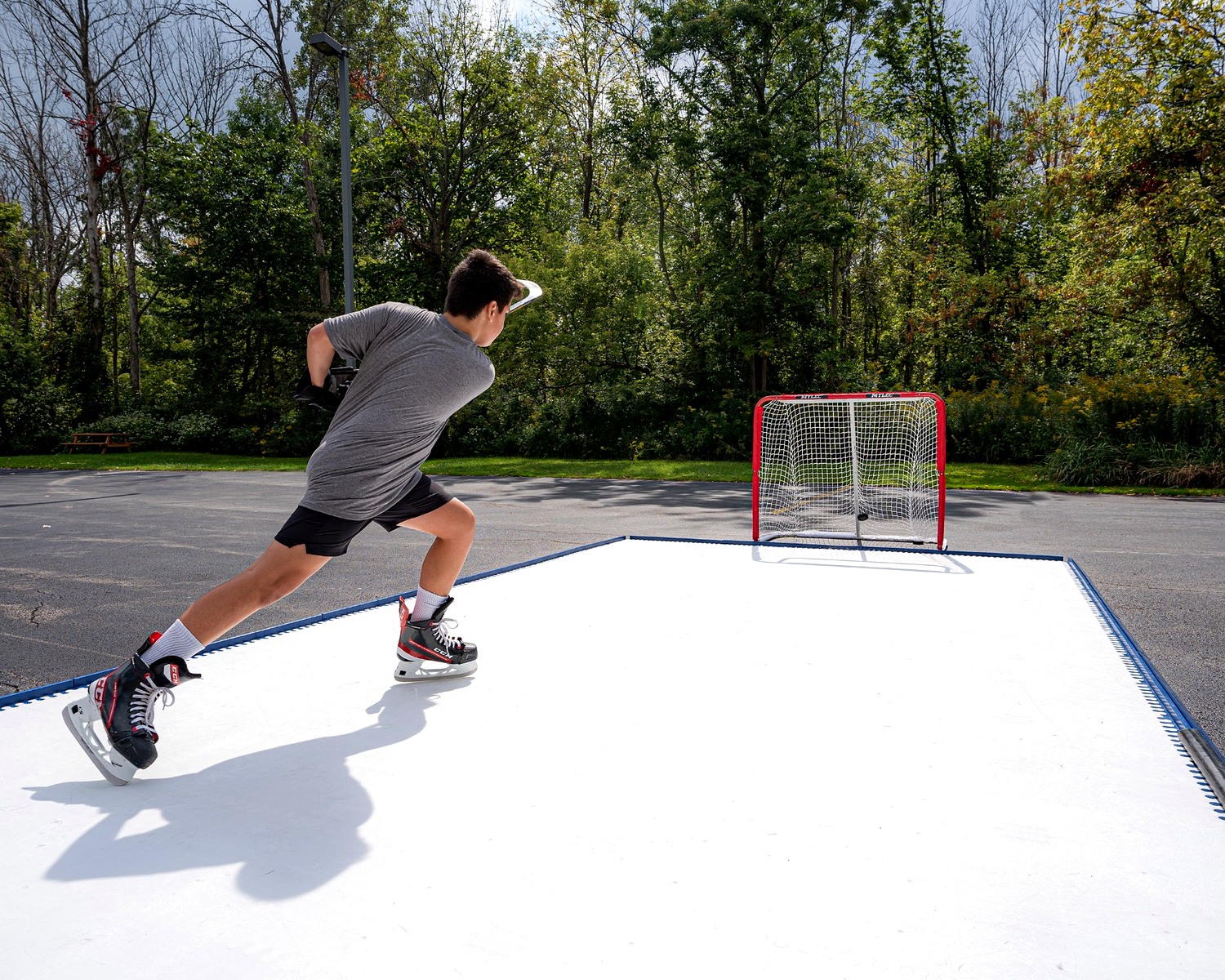
Modern synthetic ice panels create a skateable surface that can be installed indoors or outdoors without water or refrigeration. Skaters use their regular hockey or recreational skates and can practice many of the same skating and hockey skills they perform on traditional ice.
But synthetic ice and real ice are not identical, and one isn’t automatically better for every situation.
Real ice remains the benchmark for competitive skating performance. Synthetic ice’s advantage is accessibility: it makes skating possible in locations and situations where maintaining real ice would be impractical, expensive or impossible.
If you’re new to synthetic skating surfaces, start with our complete guide to synthetic ice to learn how the panels work, where they can be installed and how to plan a rink.
Here’s how synthetic ice and real ice compare.
Synthetic Ice vs. Real Ice at a Glance
| Feature | Synthetic Ice | Real Ice |
|---|---|---|
| Skating Surface | Engineered polymer panels | Frozen water |
| Refrigeration Required | No | Usually, except naturally frozen outdoor rinks |
| Water Required | No | Yes |
| Regular Skates | Yes | Yes |
| Indoor Use | Yes | Yes |
| Outdoor Use | Yes | Climate/season dependent without refrigeration |
| Year-Round Use | Yes | Requires refrigeration in most climates |
| Installation | Modular panels | Specialized rink infrastructure for refrigerated ice |
| Maintenance | Cleaning and normal surface care | Resurfacing plus refrigeration/ice maintenance |
| Operating Energy | No refrigeration energy required | Refrigeration is a major energy load |
| Expandable/Portable | Yes | Generally no |
| Best Pure Skating Performance | Very good with quality panels | Excellent |
| Hockey Training | Excellent for additional repetitions and practice | Competition standard |
The biggest difference isn’t simply how the two surfaces feel beneath your skates. It’s what is required to create and maintain the skating environment.
Does Synthetic Ice Feel Like Real Ice?
This is usually the first question skaters ask.
The answer is: similar, but not identical.
A properly maintained real-ice surface provides extremely low resistance between the skate blade and the ice. That’s the skating experience hockey players and figure skaters know best.
Synthetic ice creates glide differently. The skate blade travels across an engineered polymer surface rather than frozen water. High-quality synthetic panels are specifically designed to reduce friction and create a smooth skating experience, but a skater will generally feel more resistance than on real ice.
That isn’t necessarily a disadvantage for training.
The additional resistance can require a player to work harder through strides and movements. More importantly, a home synthetic rink gives players something that’s often difficult to obtain on traditional ice: access and repetition.
Instead of waiting for the next practice, open-skate session or rented ice time, a player can walk into the garage, basement or backyard, put on their skates and train.
That’s why synthetic ice should not necessarily be viewed as a replacement for a hockey player’s regular ice time. For many players, it’s an opportunity to add more skating time to it.
Our article on why more skating time can improve hockey development explores this training advantage in greater detail.
Can You Use Regular Skates on Synthetic Ice?
Yes.
Quality synthetic ice is designed for use with regular hockey and recreational ice skates. You don’t need rollerblades or a special type of hockey skate.
Skate Anytime panels are designed to work with standard hockey and recreational skates, allowing players to practice actual skating movements rather than simply simulating them off-skates.
That distinction is especially important for hockey training.
Players can work on skills such as:
- Starts and stops
- Forward and backward skating
- Edge work
- Turns and transitions
- Stickhandling while skating
- Passing and receiving
- Shooting in motion
- Goalie movement and positioning
This creates an entirely different training environment from a traditional dryland shooting pad.
Hockey Training: Synthetic Ice vs. Real Ice
For an actual hockey game, real ice wins. That’s the surface on which the sport is played.
For additional hockey training, however, the comparison becomes much more interesting.
Ice availability is finite. Players have practices, games, clinics and perhaps occasional private ice time. Adding more traditional ice usually means finding available rink time, traveling to the facility and paying for additional ice.
A synthetic ice training area changes that equation.
A player with a surface in a basement, garage, training facility or backyard can work on hockey skills whenever time is available—even for 15 or 20 minutes.
That makes synthetic ice particularly useful for high-repetition training.
Instead of asking:
“Is synthetic ice better than real ice?”
A better question for hockey development may be:
“How can synthetic ice help me get more meaningful repetitions when real ice isn’t available?”
We’ve been helping players create home skating and hockey-training environments for more than 15 years, from smaller development surfaces to larger home training centers.
For more on hockey-specific applications, see our guide to the benefits of synthetic ice for hockey players.
Installation: A Major Difference Between Synthetic and Real Ice
This is where the two rink types begin to separate dramatically.
A permanent refrigerated ice rink is an engineered facility. Maintaining a frozen surface requires refrigeration equipment and involves heat loads from the building, lighting, skaters, resurfacing and the surrounding environment. ASHRAE’s engineering guidance for ice rinks specifically addresses refrigeration loads, temperature and humidity control, insulation, pumping systems and other building systems required to maintain ice.
Synthetic ice doesn’t need to be frozen.
Interlocking panels are installed over an appropriate hard, flat surface to create the skating area. That makes synthetic ice practical in places where installing refrigerated ice would make little sense.
Examples include:
Homes: basements, garages, driveways and backyards.
Hockey facilities: training centers, shooting areas and goalie-development spaces.
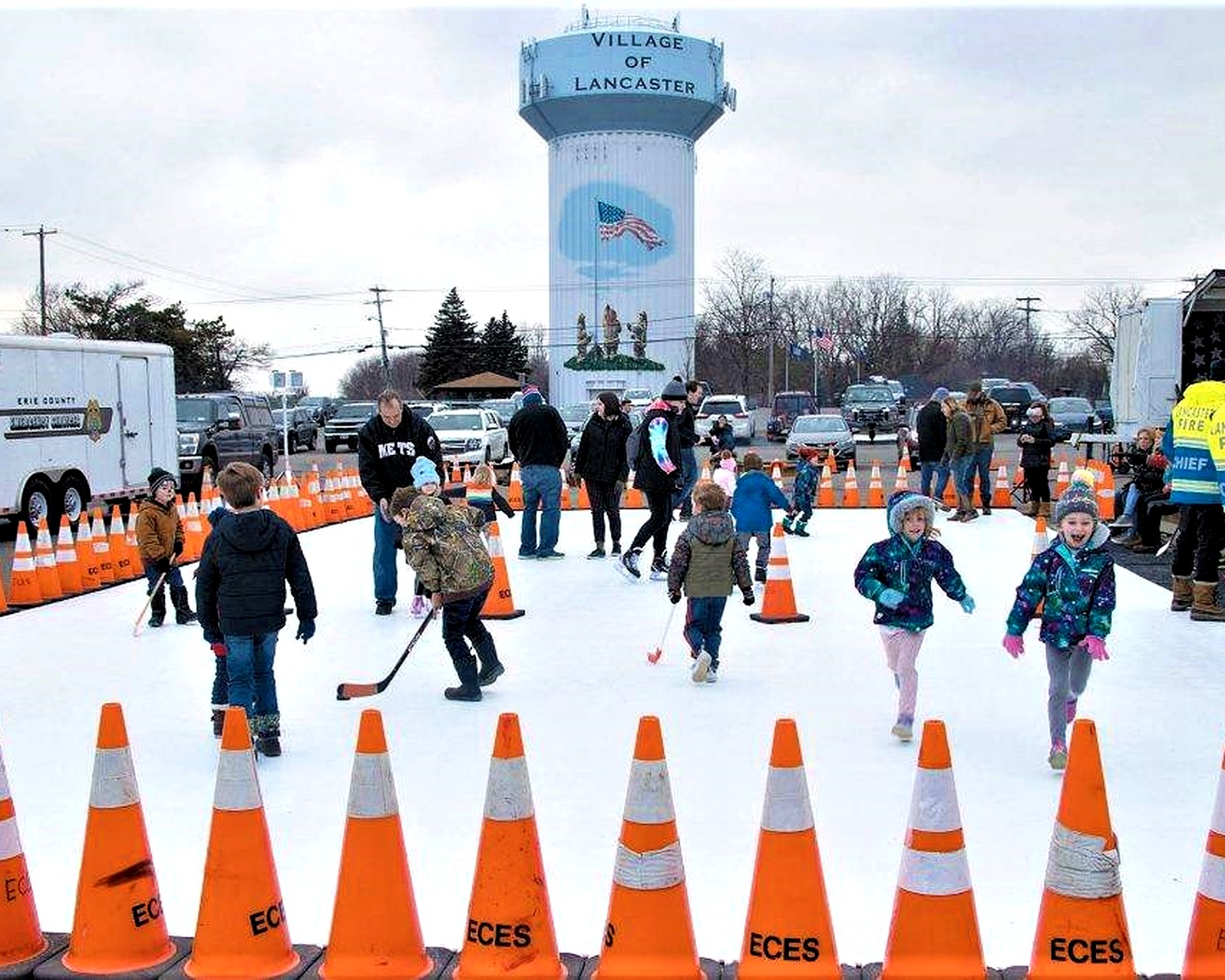
Community recreation: parks, community centers, schools and youth organizations.
Commercial applications: hotels, resorts, shopping centers and entertainment venues.
Events: holiday attractions, festivals, corporate events and temporary skating experiences.
And because the rink consists of modular panels, it can be expanded or reconfigured later.
That’s a fundamentally different infrastructure proposition from building refrigerated ice.
Maintenance: Synthetic Ice vs. Real Ice
Every skating surface requires some care, but the maintenance requirements are quite different.
Real Ice
Real ice must remain frozen and in suitable skating condition.
Depending on the facility, that means managing refrigeration, ice temperature, humidity, ice thickness and resurfacing. The International Ice Hockey Federation’s arena guidance notes that ice thickness and temperature affect both maintenance and energy consumption.
Synthetic Ice
Synthetic ice doesn’t melt and doesn’t need resurfacing with water.
Routine maintenance primarily involves keeping the skating surface clean and removing dirt and debris that can interfere with skating performance.
There is no refrigeration plant to operate and no ice sheet to remake.
For a homeowner, municipality, school or business that wants to offer skating without operating an ice facility, that can be one of synthetic ice’s biggest advantages.
Operating Cost: Where Synthetic Ice Has a Major Advantage
Comparing purchase price alone doesn’t tell the whole story.
A refrigerated rink has ongoing operating expenses associated with maintaining frozen ice. Refrigeration, heating, ventilation, dehumidification, lighting, resurfacing and other building systems all contribute to energy use.
The University of Illinois’ EnergySense program notes that ice arenas are inherently large energy users and identifies refrigeration as the largest component in a typical arena’s energy consumption.
Synthetic ice eliminates the energy required to refrigerate the skating surface.
Once the panels are installed, there is no refrigeration system required to keep the surface skateable.
That distinction becomes increasingly important when evaluating larger community, recreational, commercial and event rinks where the objective is to provide a skating experience rather than reproduce a regulation refrigerated arena.
Which Surface Is Better Outdoors?
This is another area where synthetic ice provides a different kind of flexibility.
Traditional outdoor ice is highly dependent on temperature unless a refrigeration system is installed.
Warm weather, sunlight, rain and changing temperatures can all affect an outdoor real-ice surface. ASHRAE specifically identifies solar exposure, wind, rain and ambient conditions as considerations in determining refrigeration requirements for outdoor ice.
Synthetic ice doesn’t have to stay frozen.
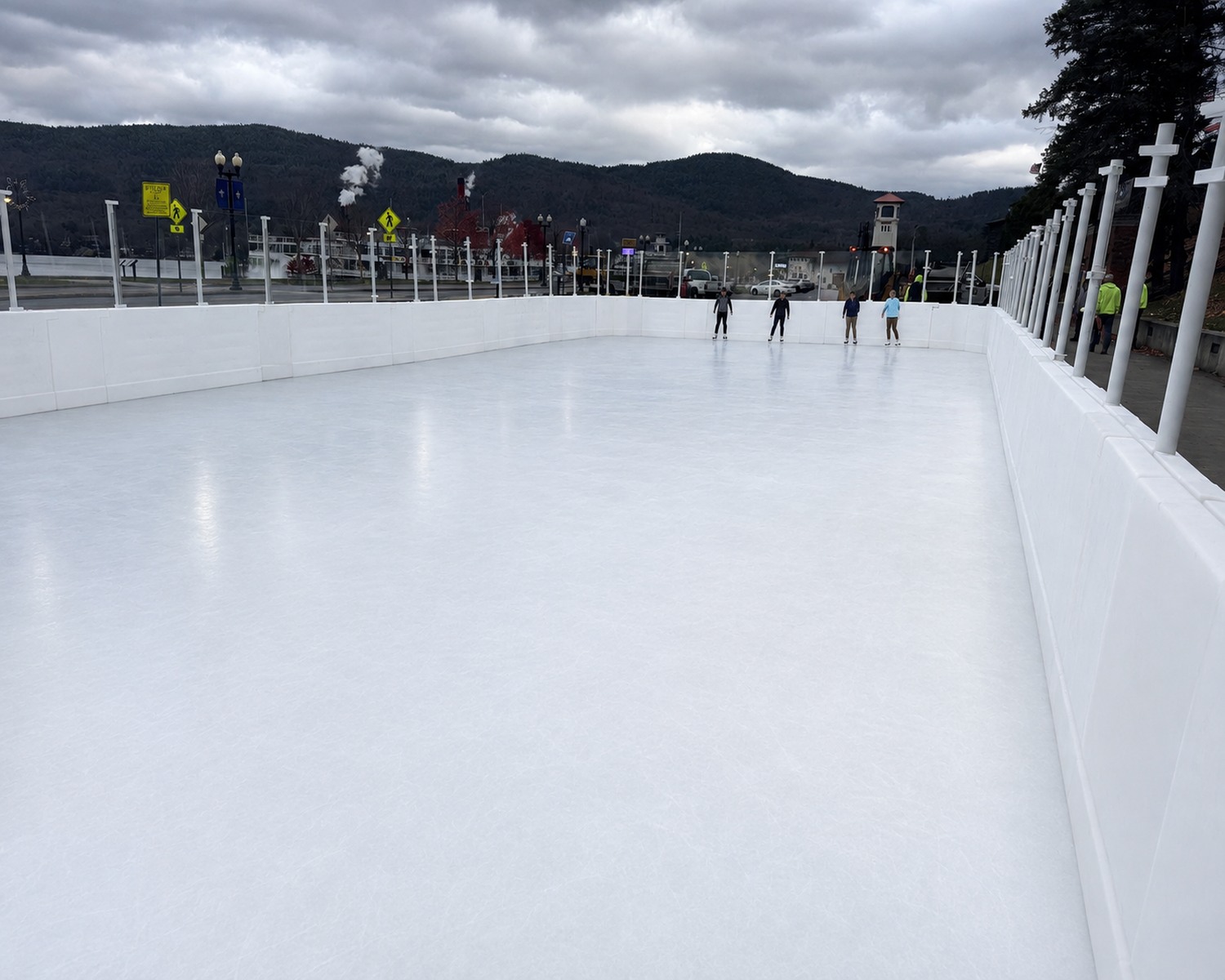
Skate Anytime panels can be used indoors or outdoors, allowing a rink to operate through seasons and climates where natural ice isn’t practical.
That can turn a backyard, patio, community space or commercial property into a skating area without waiting for winter.
Learn more about creating an outdoor or backyard synthetic ice rink.
What About Energy and Environmental Impact?
This comparison deserves some nuance.
Synthetic ice is a manufactured polymer product, so manufacturing the panels has an environmental footprint. It would therefore be misleading to describe synthetic ice as having no environmental impact.
Its major operational difference is that the skating surface does not require continuous refrigeration or resurfacing water.
Traditional refrigerated ice facilities have significant energy requirements. The IIHF’s sustainability guidance identifies refrigeration as one of the largest energy uses in conventional ice arenas, along with heating, ventilation, dehumidification and lighting.
The environmental calculation for any specific project depends on rink size, facility design, climate, usage, energy source, expected life and other factors.
But if the goal is simply to create a skateable recreational or training surface, eliminating the need to continuously freeze and maintain a sheet of water can dramatically simplify the infrastructure required.
Synthetic Ice vs. Real Ice for Home Hockey Training
For most homeowners, this is a fairly easy comparison.
Building and operating a refrigerated rink in a basement or garage isn’t practical.
Synthetic ice makes it possible to create a permanent skating and hockey-training area using space you already have.
A smaller surface can provide room for:
- Edge work
- Puck handling
- Shooting
- Passing
- Starts and stops
- Goalie training
- Skill-development drills
Larger spaces allow players to combine those individual skills into more dynamic skating drills.
And the rink doesn’t have to be built all at once. Modular panels allow you to start with the space and budget you have today and expand later.
For home projects, you can Build My Rink and instantly price a custom-size synthetic ice surface.
Synthetic Ice vs. Real Ice for Communities and Recreation
The decision becomes more complex for municipalities, schools, nonprofits and community organizations.
If the objective is competitive hockey or figure skating, a properly designed refrigerated rink may be necessary.
But if the objective is to create an accessible recreational skating attraction, synthetic ice can eliminate much of the infrastructure associated with a traditional ice facility.
A community can potentially create skating in:
- Parks
- Community centers
- Downtown districts
- Schools
- Recreation facilities
- Seasonal attractions
- Multi-use spaces
The rink can also potentially be removed or reconfigured when the space is needed for another activity.
That’s why we see synthetic ice as particularly compelling when the question isn’t “How do we build an ice arena?” but rather “How do we bring skating to our community?”
Our article on synthetic ice rinks for towns, villages and municipalities explores that application in more detail.
Synthetic Ice vs. Real Ice for Events and Commercial Applications
Temporary and event skating is another situation where portability matters.
A traditional refrigerated event rink requires the equipment and infrastructure necessary to create and maintain ice. Synthetic ice panels can instead be transported, assembled, skated on, disassembled and stored for another event.
The same inventory of modular panels can also be configured into different rink dimensions depending on the available space.
That can make synthetic ice attractive for:
- Holiday events
- Winter festivals
- Party rental companies
- Hotels and resorts
- Shopping centers
- Corporate events
- Community celebrations
- Seasonal attractions
For organizations evaluating a larger project, the relevant comparison is therefore about more than skating feel. Installation, portability, operating requirements, available space, intended use and total project cost all matter.
So, Is Synthetic Ice Better Than Real Ice?
Neither surface wins every category.
Real ice remains the standard for competitive hockey and skating. If your goal is to reproduce the exact playing surface used in a hockey game, real ice is the answer.
Synthetic ice wins on accessibility and flexibility.
It allows people to skate where traditional ice isn’t practical and gives hockey players opportunities for additional training without waiting for rink availability.
For homeowners, it can mean skating in the basement or garage.
For hockey players, it can mean hundreds or thousands of additional repetitions.
For communities, it can mean offering skating without constructing a refrigerated ice facility.
For businesses and event operators, it can mean creating a portable skating attraction that can be installed, removed and reconfigured.
That’s the real value proposition:
Synthetic ice doesn’t have to replace real ice to be valuable. It creates opportunities to skate when and where real ice isn’t available.
Planning a Synthetic Ice Rink?
The right rink depends on what you want to accomplish.
For smaller home and hockey-training surfaces, use Build My Rink to enter your dimensions and explore different rink configurations.
Planning a larger home rink, community rink, school project, training facility, commercial installation or event rink? Use Plan My Rink. Tell us about your space and intended use, and our team can help with rink sizing, layout, product recommendations, project pricing and delivery planning.
Frequently Asked Questions About Synthetic Ice vs. Real Ice
Does synthetic ice feel exactly like real ice?
No. Quality synthetic ice provides an ice-like skating experience, but the surface generally has more resistance than well-maintained real ice. For many applications, the benefit is the ability to skate and train year-round without refrigeration.
Can I use my regular hockey skates on synthetic ice?
Yes. Skate Anytime synthetic ice is designed for use with standard hockey and recreational ice skates.
Is synthetic ice good for hockey training?
Yes. Synthetic ice allows players to train on skates and practice edge work, starts and stops, stickhandling, passing, shooting and other hockey-specific skills. Its biggest advantage is accessibility—you can train when traditional ice isn’t available.
Does synthetic ice dull skate blades faster?
Synthetic ice creates more friction against the blade than real ice, so skates will generally require sharpening more frequently. How often depends on skating frequency, skating style, surface cleanliness and blade condition.
Does synthetic ice need refrigeration?
No. Synthetic ice is an engineered polymer skating surface and doesn’t need to be frozen, refrigerated or resurfaced with water.
Can synthetic ice be used outside?
Yes. Skate Anytime synthetic ice can be installed indoors or outdoors on an appropriate hard, flat surface.